Architecture and Landscape Architecture
A Designer’s Thinking Process, Seen Through Frank Lloyd Wright’s Fallingwater
*image licensed by R London, CC BY-SA 3.0 via Wikimedia Commons
A new possibility for landscape context in design for Architecture
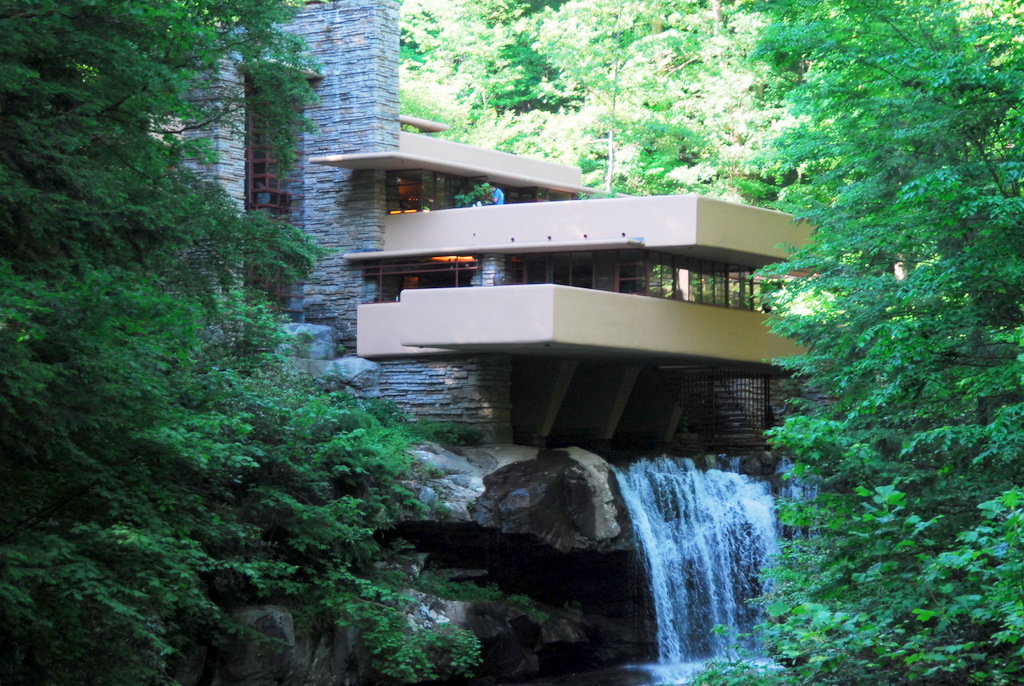
The Kaufmann family commissioned Fallingwater as a weekend home at Bear Run. A conventional response could have placed the house downstream, where the waterfall would become a picturesque object in the distance. Wright chose something more radical: the house would rise above the falls, anchored to the rock and extended outward in reinforced-concrete terraces. That decision changed the waterfall from scenery into experience. From inside the house, the water is not simply framed like a painting. It is heard continuously. The air, humidity, rock, forest, changing light, and movement of the stream become part of daily life. A stair descends from the living room toward the water, while terraces project into the landscape like the natural ledges of the ravine. For me, this is where architecture and landscape architecture become inseparable. Wright did not place an object beside a landscape. He organized human experience through the landscape itself. The sound of water becomes a material. The rock becomes both foundation and interior surface. The terraces become inhabited topography.
The waterfall is not merely the view. It is the atmosphere, the sound, the structure, and the reason for the house.
Somach, licensed under CC BY-SA 3.0 via Wikimedia Commons
The difficult site was the design opportunity.
Why would Wright choose the most difficult setting? A flatter site would have been easier to engineer, easier to construct, and less risky. The answer, I believe, is that a great designer often sees the constraint as the source of identity. More importantly, I see the decision as a challenge Wright set for himself. Great designers do not simply compete with other designers; they compete with their own previous achievements. They resist settling into a comfortable formula, even after they have already earned recognition. Wright could have repeated an easier and commercially safer type of house. Instead, he asked himself to make architecture and moving water become one experience. The ledges, stream, trees, and steep ravine were not obstacles to be removed before design could begin. They were the project’s essential vocabulary. Wright’s stacked horizontal terraces echo the rock formations, while the vertical stone chimney anchors the composition. The building gains its power precisely because it accepts the site’s difficulty. This does not mean difficulty is automatically virtuous. Fallingwater developed serious structural and moisture problems, and its cantilevers eventually required major stabilization. Design courage must be matched by engineering discipline, technical review, and long-term stewardship. Still, without the original risk, there would be no Fallingwater as we know it.
Great designers challenge themselves. They refuse to settle comfortably inside what they already know how to do.
Could Fallingwater be permitted today?
From today’s professional perspective, the site immediately raises questions. A contemporary project over a stream could involve floodplain rules, stream or riparian buffers, environmental review, stormwater requirements, structural codes, life-safety provisions, and approvals from several authorities. Depending on the jurisdiction, the concept might be heavily restricted or require variances and specialized permits. That regulatory complexity does not make Wright’s thinking irrelevant. It makes the designer’s task more disciplined. The contemporary challenge is to identify the strongest experiential idea early, then work with engineers, environmental specialists, and reviewing authorities to discover what form of that idea can responsibly survive. A great concept should not ignore regulation. It should be strong enough to evolve through regulation without losing its soul.
Did Wright think first—or draw first?
The famous story of Fallingwater’s first drawings is almost unbelievable. According to accounts from several Taliesin apprentices, Wright produced the initial plan, section, and perspective in a matter of hours when Edgar Kaufmann unexpectedly announced that he was coming to see the design. The first drawings were also remarkably close to the final concept.It would be easy to conclude that the building appeared spontaneously. But that interpretation misses the deeper process. Wright had visited the site, studied its survey, understood its rocks, trees, topography, and waterfall, and carried decades of architectural experience with him. Before the pencil moved quickly, the mind had been working slowly. The lesson is not that mature designers should avoid drawing. Sketching remains one of our most powerful ways to investigate, test, and discover. The lesson is that drawing is not the whole of design. A designer is working while walking the site, listening to water, remembering earlier projects, comparing alternatives internally, and allowing an idea to mature before it becomes visible.
Before the pencil moved quickly, the mind had been working slowly.
Experience is stored design intelligence.
Fallingwater did not come from an empty mind. Wright had already designed hundreds of projects and developed a language of horizontal planes, open interiors, central hearths, cantilevers, natural materials, and buildings integrated with their sites. At Bear Run, those earlier investigations were not copied; they were recombined and transformed for a singular place. This is encouraging for experienced designers. Previous work is not simply history in a portfolio. It becomes an internal library of spatial judgment: what has worked, what has failed, what can be adapted, and what should be attempted differently. High-quality experience gives a designer more possibilities to draw upon—and greater responsibility in choosing among them.
A late-career return—and a challenge to designers.
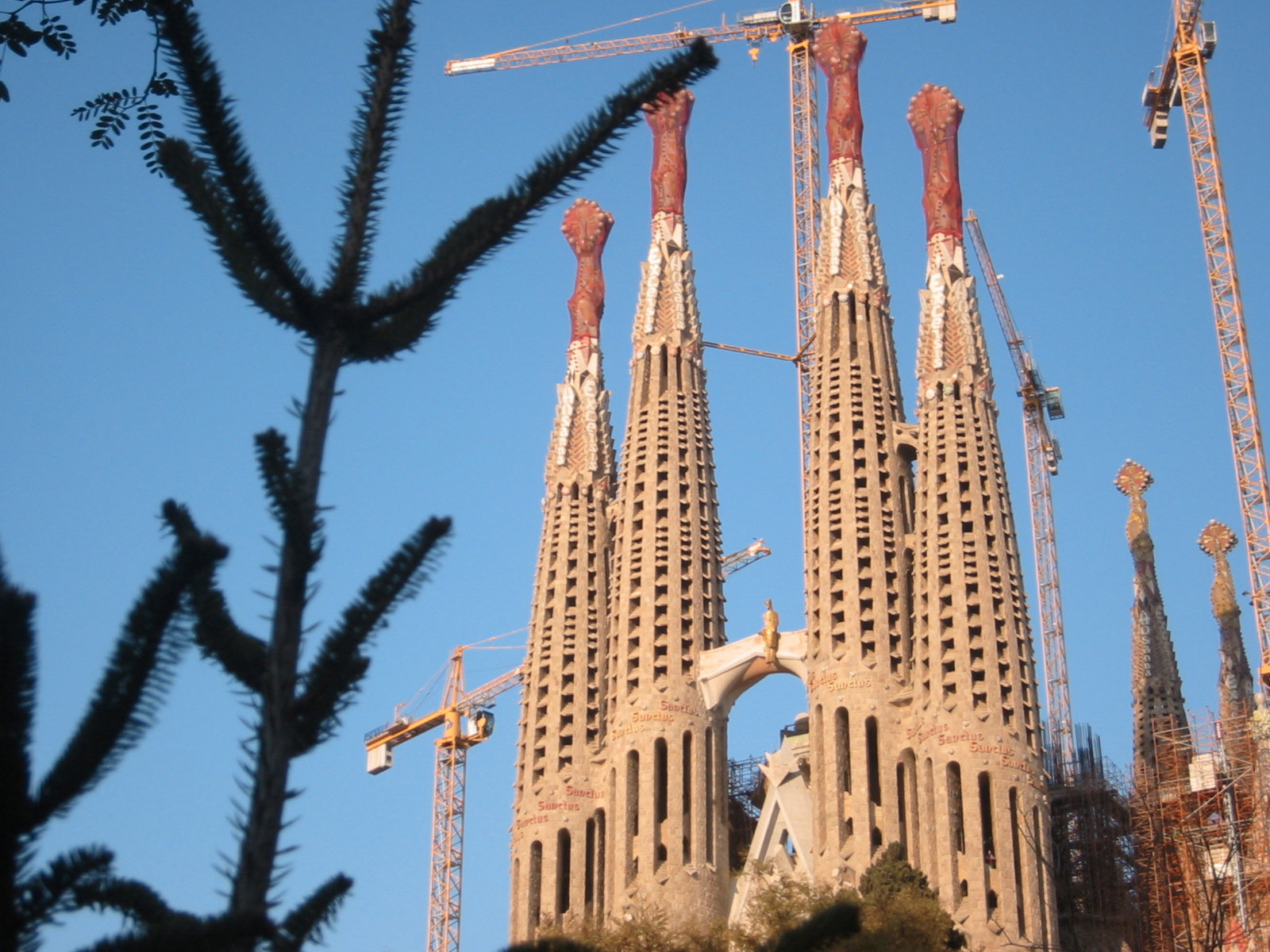
Wright received the Fallingwater commission in 1935 when he was 67, turning 68 that June. The preceding years had been financially difficult; commissions were scarce, and many people considered his most important career to be behind him. Instead, Fallingwater became part of a remarkable late-career return. That fact may be as inspiring as the building itself. Wright did not respond to hardship by reducing his ambition to safe production. He did not settle down inside the reputation he had already built. He deliberately chose a demanding site and an idea that required him to test his own ability again. Antoni Gaudí offers a powerful parallel in the Sagrada Família.
Sagrada Família, photograph by Jeremy Keith, via Wikimedia Commons, licensed under CC BY 2.0
He did not need to conceive towers of such extraordinary height and complexity to create a meaningful church. A lower and simpler solution would have been easier to engineer, finance, approve, and complete. Yet he challenged himself with an ambition that extended beyond the practical limits of his own lifetime. The towers were not merely additional construction; they represented the height of the question he was willing to ask himself. This is what I recognize in both Gaudí and Wright: the great designer does not settle after success. Each important project becomes a new personal test. The designer asks, “Can I go beyond what I have already done without losing the integrity of the work?” If every project were pursued at this level of ambition, budgets, schedules, and permit departments might collapse. But without a few designers willing to challenge what appears reasonable, architecture would lose much of its cultural meaning. Today, both Fallingwater and Gaudí’s work are recognized by UNESCO. That recognition does not erase their technical difficulties or complicated histories. It confirms that society sometimes receives its greatest long-term value from projects that were not optimized for short-term ease.
The most important tool is thinking.
What, then, is most important for a designer? My answer is thinking—not vague inspiration, but sustained and informed attention. Thinking means understanding the site before imposing form. It means carrying the project beyond billable hours and beyond the drafting table. It means drawing from experience without repeating oneself. It means recognizing which difficulty gives a project meaning and which difficulty is merely waste. It also means knowing when an ambitious idea needs stronger engineering, more research, or a different path through regulation. Fallingwater reminds me that the visible sketch may be the final release of a much longer invisible process. The hand can draw quickly only when observation, memory, experience, and imagination have already been at work. A designer’s real work begins before the line—and continues long after it.
Sources and further reading
•3 Architecture - Twentieth-Century Houses by Robert McCarter, Phaidon
Fallingwater: “Designing Fallingwater”: https://fallingwater.org/history/the-kaufmanns-fallingwater/designing-fallingwater/• Fallingwater: “What Is Fallingwater?”: https://fallingwater.org/what-is-fallingwater/• Frank Lloyd Wright Foundation: “The Life of Frank Lloyd Wright”: https://franklloydwright.org/frank-lloyd-wright/• UNESCO: “The 20th-Century Architecture of Frank Lloyd Wright”: https://whc.unesco.org/en/list/1496/